Related Posts
Everything you need to know about Commercial Suits and Disputes.
14 Jul 2026
# Precautionary Measures Before Buying a Property in India: A Complete Legal Checklist
05 Jul 2026
Company Registration in India: A Practical Guide for Entrepreneurs
30 Sep 2026
MSME LEGAL COMPLIANCE SERVICES IN INDIA
09 Sep 2026What is Civil Litigation? A Complete Guide Under Indian Law
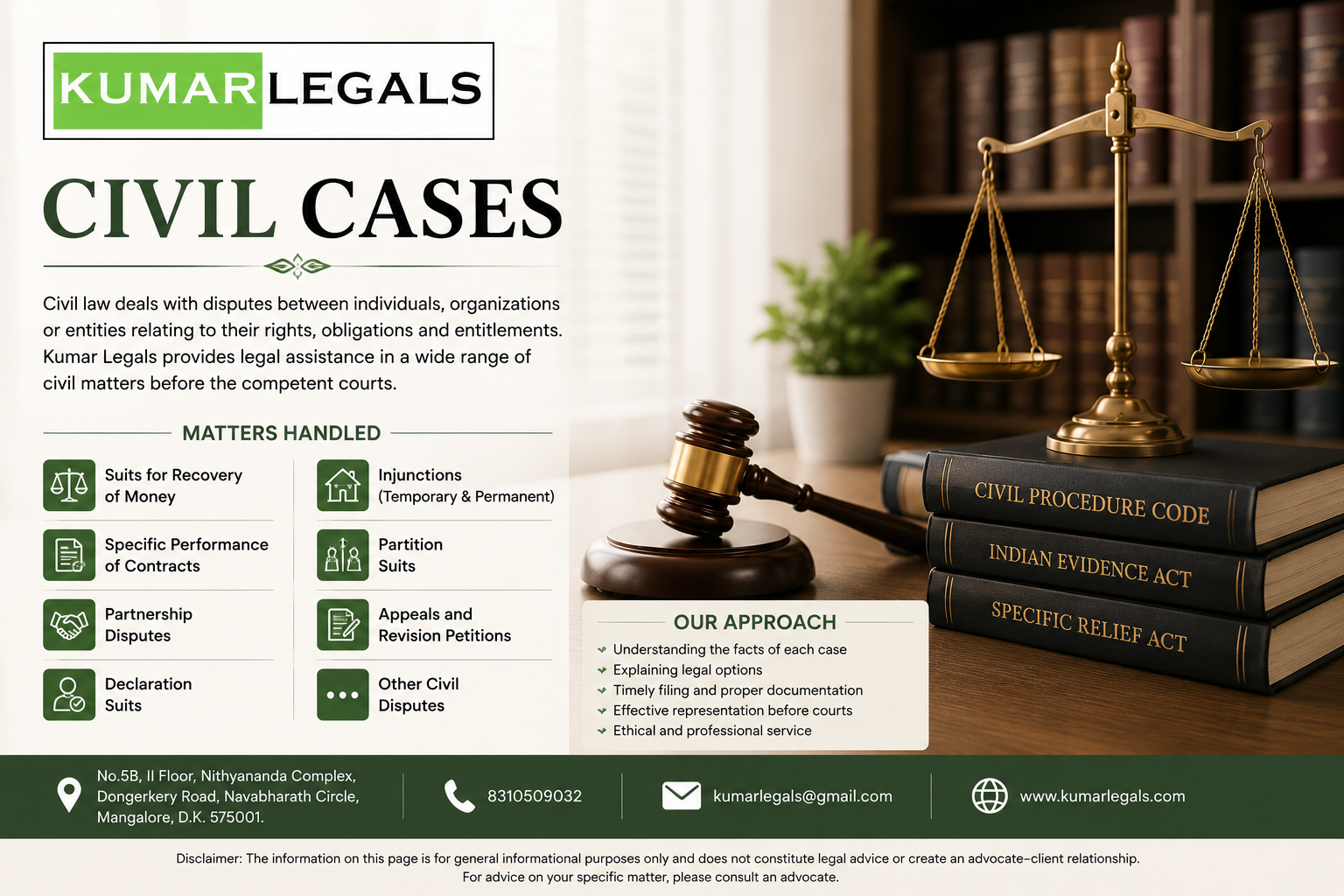
Civil litigation refers to the legal process through which disputes between individuals, businesses, organisations or other entities are resolved before a competent civil court. Unlike criminal proceedings, civil litigation primarily concerns the enforcement of private legal rights and obligations. The objective of a civil court is to determine the rights of the parties and grant appropriate civil remedies as recognised by law.
In India, civil proceedings are principally governed by the Code of Civil Procedure, 1908 (CPC), together with the Indian Evidence Act, 1872 (or the Bharatiya Sakshya Adhiniyam, 2023 where applicable), the Limitation Act, 1963 and other special enactments depending upon the nature of the dispute.
Common Types of Civil Litigation
Civil litigation includes a wide variety of disputes, including:
- Partition suits
- Property disputes
- Permanent and mandatory injunction suits
- Money recovery suits
- Specific performance of contracts
- Declaration suits
- Easement disputes
- Landlord and tenant disputes
- Commercial disputes
- Contractual disputes
Each category of dispute follows its own legal principles in addition to the general procedural framework contained in the Code of Civil Procedure.
Purpose of Civil Litigation
The purpose of civil litigation is to enable parties to resolve disputes through the judicial process. Depending upon the circumstances, a civil court may grant declarations, injunctions, possession of property, recovery of money, specific performance of contracts or other reliefs recognised under the applicable law.
General Stages of a Civil Suit
- Legal consultation and evaluation of the dispute
- Preparation of documents
- Institution of the suit before the competent court
- Issue of summons
- Appearance of parties
- Written Statement
- Framing of Issues
- Recording of Evidence
- Arguments
- Judgment
- Execution Proceedings, where required
Who Can File a Civil Suit?
Any person claiming that a legal or civil right has been infringed may institute civil proceedings before the court having jurisdiction, subject to the applicable statutory provisions, limitation periods and maintainability requirements.
Civil Litigation in Mangalore
Civil disputes arising within Mangalore and Dakshina Kannada are ordinarily adjudicated before the competent Civil Courts having territorial and pecuniary jurisdiction, depending upon the facts of each case.
Frequently Asked Questions
Is every property dispute a civil case?
Many property disputes are civil in nature, although certain situations may also involve criminal proceedings depending upon the facts.
Can civil disputes be settled outside court?
Yes. Depending upon the nature of the dispute, parties may explore settlement, mediation or arbitration where legally permissible.
How long does a civil case take?
The duration depends upon several factors including the complexity of the dispute, evidence, court workload and procedural requirements.
Disclaimer: This article is intended solely for general informational purposes and should not be construed as legal advice. Every legal matter depends upon its own facts and applicable law.